
Feed Only vs. Standard Shopping: Why It's Time to Bring Shopping Campaigns Back

Updated: Sep 3
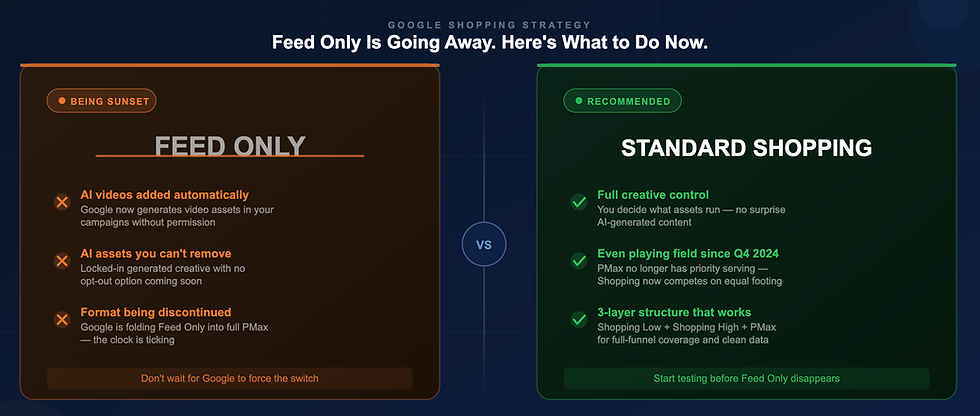
If you've been running Feed Only campaigns inside Performance Max as an alternative to full PMax, it's time to start paying attention to this change that will impact your campaign.
The Writing Is on the Wall for Feed Only Campaigns
Feed Only campaigns are going away. I know that's not what a lot of advertisers want to hear, especially those who adopted them specifically to avoid the AI-generated creative assets that come bundled with standard Performance Max. But the time to adapt is now before Google forces your hand. Here's what's happening, what it means for your account, and what I'd recommend doing today.
What's Changing with Feed Only Campaigns
Google has been rolling out a series of changes to Feed Only campaigns that should make every advertiser sit up and take notice:
AI-generated videos are coming. Google has started automatically generating video assets within Feed Only campaigns. This is the same type of auto-created content that many advertisers objected to in full Performance Max. Previously, Feed Only was a way to stay in the PMax ecosystem while maintaining tighter creative control.
AI-generated assets you can't remove. The next step in this rollout is AI-generated assets that are baked into your campaigns without the option to opt out or delete them. If creative control is a priority for your brand or your clients, this is a significant development.
Feed Only as a format is being sunset. Google hasn't made a formal announcement with a hard deadline yet, but the signals are consistent: Feed Only is being folded into standard PMax or phased out entirely. If you're waiting for an official memo before acting, you'll be reacting instead of planning.
The Q4 2024 Change To Campaign Priorities
Here's something that not everyone is aware of: in Q4 of 2024, Google changed how Performance Max and Standard Shopping campaigns serve against one another.
Previously, Performance Max had priority serving. When both PMax and a Standard Shopping campaign were eligible to serve for the same query, PMax won. This effectively pushed Standard Shopping to the margins for most advertisers running both simultaneously , which is part of why so many accounts abandoned Shopping campaigns altogether once PMax became the default recommendation. That changed in Q4 2024.
PMax no longer automatically outcompetes Standard Shopping. Both campaign types enter the auction on equal footing, and Google's systems determine which serves based on relevance and bid, not a built-in hierarchy. This is a key reason why bringing Standard Shopping campaigns back into the mix makes sense right now.
Why I'm Recommending Standard Shopping Alongside PMax
With Feed Only on its way out and the serving dynamics now leveled, the strategic case for Standard Shopping has never been stronger. Here's how I'm thinking about campaign structure for shopping accounts:
Shopping Low + Shopping High + PMax
The approach I'm recommending for most e-commerce accounts is running three distinct layers:
Shopping Low — A Standard Shopping campaign targeting your lower-priced or entry-level products with a more aggressive CPC or tROAS target. This captures price-sensitive searches, drives volume, and can function as a testing ground for new SKUs or seasonal pushes.
Shopping High — A Standard Shopping campaign built around your premium products, higher-margin items, or products with strong brand equity. This lets you apply a distinct bidding strategy and budget allocation that's calibrated to the value of those conversions, rather than averaging everything together inside PMax.
Performance Max — Still in the mix, but as one layer in a balanced structure rather than the single campaign doing everything. PMax continues to work well for broad discovery, YouTube inventory, and reaching users earlier in the funnel. With the serving changes from Q4 2024, it no longer cannibalizes your Shopping campaigns the way it used to.
This three-layer approach gives you more control over how budget is allocated across your product catalog, cleaner performance data by product tier, and a hedge against the continued changes Google is making to Feed Only and PMax asset generation.
Start Testing Now Before Feed Only Disappears
The worst time to build a Standard Shopping campaign is after Google pulls Feed Only out from under you. Testing takes time. You need to let campaigns build history, calibrate bidding, and gather data before you can draw conclusions and Google's auction learns from your campaigns the same way. Starting from zero when you're forced to is a disadvantage.
My recommendation: launch at least one Standard Shopping campaign in the next 30 days if you aren't already running one. It doesn't have to be your full catalog or your entire budget. A focused test on a product segment you understand well is enough to start building data and confidence.
Watch how it performs relative to your Feed Only campaigns and how it interacts with PMax now that the serving dynamics have changed. And when Google eventually kills Feed Only, you won't be scrambling.
What This Means If You're Running PMax-Only
If your account is currently running Performance Max as its only campaign type — no Standard Shopping, no Feed Only — now is a good time to revisit that structure.
Adding a Shopping Low and Shopping High layer doesn't mean you're abandoning PMax. It means you're building a structure that's more resilient, more controllable, and better positioned for where Google Shopping is clearly heading.
Final Thoughts
Google is moving fast on AI-generated assets, and Feed Only was always a temporary concession. The Q4 2024 serving changes have reopened the door for Standard Shopping in a meaningful way, and with Feed Only on the way out, there's no good reason to wait.
If you're managing a shopping account right now — or working with a Google Ads consultant to get your structure right — this is the time to test Standard Shopping if you haven't already. Structure it intentionally with Shopping Low, Shopping High, and PMax working together, and you'll have more control, cleaner data, and a much smoother transition when Feed Only finally goes dark.

