
Does AI Help PPC Performance Or Just Create More Work?
Updated: Aug 20
As AI transforms the industry, creating both pressure and opportunity, we’re being increasingly asked by clients and other practitioners: Has AI improved your campaigns and performance, or has it created more work? What's changed?
We’ve been using AI for about two years across client accounts for a range of tasks, from reporting, to research, and ad creative. AI has also become increasingly embedded within Google Ads itself, through automated bidding, Performance Max, automated creative and other features. In this blog we walk you through what's worked well for us, where caution is warranted with AI use, and where it’s important for the work to be still done by a human.
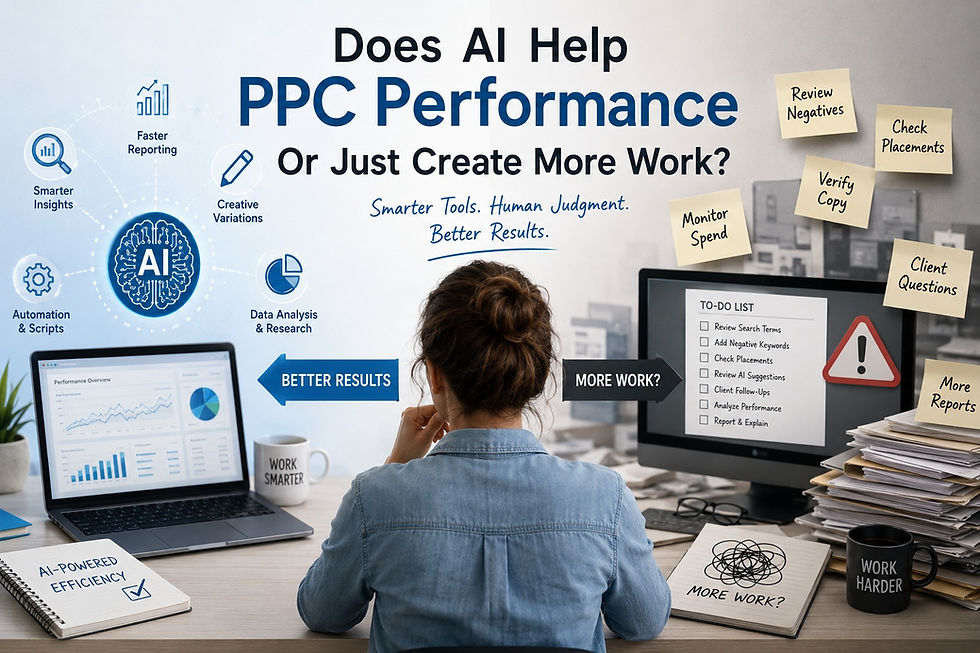
Where AI Has Helped With PPC Performance
Creative asset generation. Instead of manually drafting every headline and description variation for a responsive search ad, AI allows us to generate a batch quickly. It doesn't replace the strategic thinking behind what content to test and prioritize, but it does create a multitude of variations of headlines, descriptions, and other assets. This has allowed us to generate copy more quickly, and to test multiple ad variations alongside each other.
Client reporting and proposals. AI has been helpful at aggregating data, building standardized templates, and making reports look professional. It has also increased the efficiency of proposal development for new clients. We still use our own data and detailed notes for client reports and proposals, but AI helps them sound more polished and professional, with better formatting.
Meeting notes. We use AI to take notes during our client meetings, and then send well developed meeting summaries, including takeaways and action items, to all participants. We still check and verify these, often making changes in the process. But overall, this automation has resulted in clear time savings for us.
Negative keyword generation. AI can scan search term reports and suggest negatives, which is helpful for our routine negative keyword research. But it's far from perfect. In practice, many of AI’s suggestions are off base or inappropriate, even as they are stated with absolute confidence. So this input is to be treated with caution.
Placement exclusion reports. Similarly, we've been able to ask AI to turn a raw Display or YouTube placement report into an upload-ready exclusion list. It saves time on a tedious task. But it's also prone to errors and omissions, so all their recommendations have to be checked first. We typically use it as a ‘second set of eyes’ rather than a replacement for our own review.
Creating scripts to automate monitoring. AI makes it much easier for PPC managers who aren't developers to create relatively sophisticated scripts and tools. Things that might previously have required a developer can now be created with some effort on your own. We've built scripts that flag specific issues across accounts, such as wasted spend, tracking gaps, structural problems, and have instructed the scripts to send us automated emails at predetermined intervals for our review and consideration. We do not let these run on autopilot with automated changes turned on. Everything gets routed to our inbox to evaluate. And in many cases, we do not act upon the generated advice.
Data analysis and troubleshooting. AI can work through large amounts of data and reports and help identify patterns or anomalies that might otherwise take much longer to find manually. If conversions suddenly fall, for example, it can help narrow down whether the decline is concentrated in a particular campaign, device, location or search category. We still verify the findings against the underlying data, but it can support the investigation.
Competitor and differentiator research. We’ve successfully used AI for pulling together competitor positioning and messaging research, which we then use to inform new campaign angles, ad copy, and testing ideas. It’s been a helpful tool for landscape analysis, ad copy refresh and new positioning angles.
AI-generated imagery. We've had fun experimenting with AI-generated visual assets in campaigns. There’s a lot of room for error here, so close attention needs to be paid to any AI-generated assets. But it's a low-cost way to test new visual directions.
Crucially, across every one of these examples, we’ve used AI's output as one input to our own judgment, rather than a final answer.
Google Ads Is Already Heavily AI-Driven
Another critical dimension to this discussion is account optimization through Google's AI. AI has become increasingly embedded within Google Ads itself, through automated bidding, Performance Max, AI Max, automated creative and other features, and Google heavily pushes these features onto account managers.
Automated bidding is one clear example where this AI emphasis has created time savings. Smart Bidding can evaluate signals and make auction-level bidding decisions at a scale that isn't possible through manual bid management. But while we now spend much less time manually adjusting individual bids than PPC managers did years ago, we’re spending more time deciding what signals to give the algorithms, setting appropriate targets, monitoring where campaigns are spending money, reviewing search terms and creative, adding negative keywords, and determining whether the results align with the client's business goals. In sum, these campaigns still require active oversight.
Where Caution Is Needed
Fully outsourcing ad copy. It's tempting to think you can hand ad generation over to AI entirely, but in our testing, AI-written ad copy is often generic, off-brand, or just doesn't convert as well as the human-written assets it's supposed to replace. Often, though not always, our old, tested, human-written ads outperform the new AI-generated versions. This is why it’s useful to test any new AI generated ad copy along with the original.
Automation can create cleanup work. Automated targeting and broader matching can find opportunities a human might miss, but they can also send campaigns into wasteful areas. That can mean more search term reviews, negative keywords, placement exclusions and monitoring of automatically generated assets. The time saved in one area is thus often directly redeployed into this new type of work.
Keyword research: While we’ve used AI for keyword research and development, in practice these have tended to perform poorly, compared to those we developed on our own. While AI may be useful in surfacing keyword ideas, in our experience it’s best to treat their suggestions with caution, and to not solely rely on them.
Navigating AI usage by clients. Clients now have access to the same AI tools we do, and they're using them to ask questions, challenge recommendations, and form opinions about their own accounts. While having well informed clients is helpful, AI-generated advice can provide fully confident-sounding advice that is blatantly wrong. Clients may not always know how to tell the difference, so this can require spending extra time to educate and inform clients.
PPC Tasks We Don’t Outsource to AI
Across every example above, there's a list of tasks we as Google Ads consultants always do ourselves:
AI Oversight Checklist |
Review and contextualize AI-suggested negative keywords before adding them |
Approve placement exclusion lists before they go live |
Review automated audit findings to our email inbox for judgment, not to auto-apply |
Test AI-written ad copy against proven, human-written controls |
Contextualize AI-driven advice for clients |
Set, monitor, review and adjust budgets |
Own the final strategic call on budget, targeting, and messaging |
The Takeaway
Ultimately, AI has helped create some significant efficiencies and time savings in our work. In terms of overall performance, we are seeing impressive efficiency this year across several accounts. Looking at year-over-year performance across our entire portfolio, CTR is up 15%, CPAs are down, and ROAS is up 11% across a variety of industries with some verticals seeing better results than others. Whether that’s due to increased output helped by AI or Google’s systems evolving to better serve and meet advertisers’ goals is unclear. Another key positive impact has been that the hours we have saved through AI are getting redeployed into higher-value, more strategic work, ultimately delivering better value for clients.
At the same time, it is important to keep in mind that AI lacks context and history, and functions less like a strategist and more like an entry-level research assistant. While its output is at times impressive, it is often wrong, and always requires a pair of human eyes to review, validate and edit.
Back to the original question: has AI helped our PPC performance, or just created more work? For us, it's done both. The key has been knowing where to strategically deploy it to reap efficiencies, and where to use it as just one layer of research to inform judgement and decision making.

