Top 10 AI Tools in Google Ads
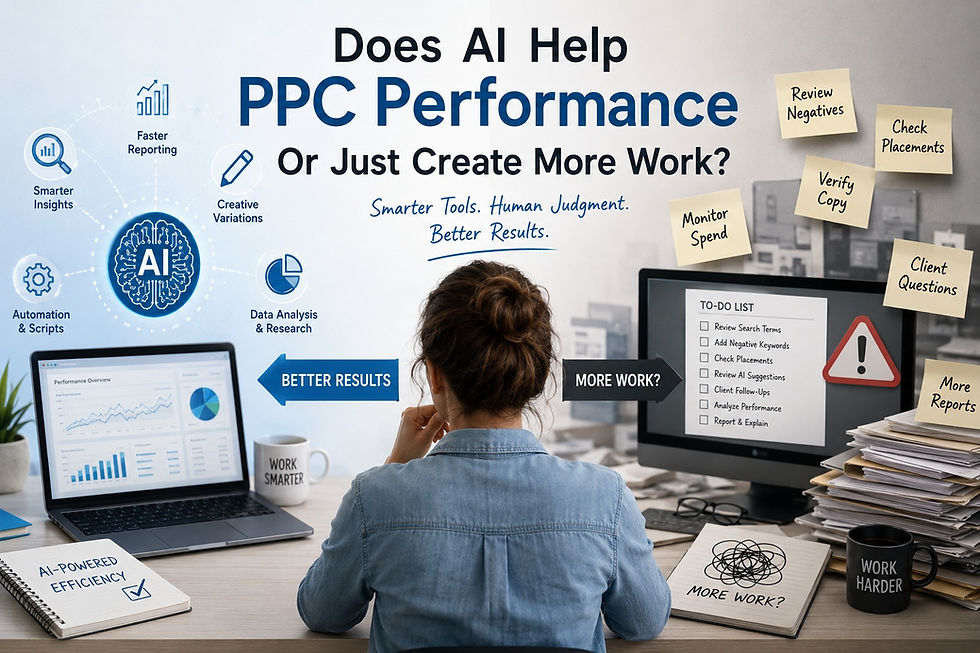
AI has rapidly become embedded into nearly every aspect of Google Ads, from campaign setup, to bidding, targeting, to ad creation and campaign analysis. While some of these tools have existed for a while, others are newer, and the platform is steadily rolling out new AI capabilities.
We are using many Google Ads AI features across client accounts. Some can save time and increase efficiency and reach, while others need to be approached carefully. This blog provides an overview and our assessment of the top 10 AI features we’ve used in Google Ads.
1. Smart Bidding
Smart Bidding is one of Google’s first AI tools for Google Ads and was a key evolution in what was previously a manual and time consuming system. Smart bidding strategies include Target CPA, Target ROAS, Maximize Conversions and Maximize Conversion Value. They use machine learning to set bids at auction time. Smart bidding can create significant efficiencies, but only works if the appropriate bidding strategy and target is picked for the specific campaign. Google’s August 17th Smart Bidding Update has also created significant performance fluctuations in many campaigns that use target CPA and Target ROAS strategies. This underscores the need for these strategies to be continually monitored and adjusted, as account realities change and as Google adjusts the parameters behind the automation.
2. AI Max for Search Campaigns
Introduced in 2025, AI Max is not a new campaign type, but rather it allows you to optimize Search campaign performance with AI through automated search term matching and asset customization. Google is heavily promoting AI Max. You may have seen a message pop-up in your account suggesting that you turn on AI Max. In our experience, AI Max has improved since its early rollout. But it does not work well for all accounts. Our recommendation is to test it first through Google Ads Experiments feature against your original setup.

3. Text Customization
Previously called Automatically Created Assets, text customization allows Google to create headlines and descriptions for your Search ads. Google uses information from your domain, landing page, existing ads and keywords to adapt messaging with generative AI to specific searches. This feature can make ads more relevant while saving time for advertisers. However, automating ad copy writing has risks and reduces control. If you opt into this feature, we recommend periodically reviewing ad copy to ensure that AI generated messaging is accurate.

4. Final URL Expansion
Final URL Expansion lets Google send users to a different page on your website when its AI determines that page is more relevant to their search than your original URL. This can help direct customers to more relevant products or services. At the same time, we periodically test different landing pages in our accounts and often use specific landing pages simply because we have the data to show they perform better. If you want to try this feature, you should configure URL exclusions for pages you don't want to advertise, such as returns or customer support pages.
5. Performance Max
Performance Max is Google's most automated campaign type, through which Google uses AI to set bids, audiences, search matching, placements, headline and description combinations and channel allocation across Google's inventory. PMax can generate significant reach and performance. We have seen it work well for multiple campaigns that were getting little traction through the traditional Search setup. At the same time, Pmax does not work for all accounts, and it requires active management, including closely monitoring and reviewing search terms, placements, assets, product performance, exclusions and ROAS.
6. Generative AI for Ad Creative
Google Ads now uses AI to help create headlines, descriptions, images, logos and even videos. When setting up an ad, advertisers provide their website, existing assets and information about their product or offering, and Google will populate creative options. While this feature can provide more varied content and save time, in practice we have encountered accuracy and relevance problems with many of the AI suggestions. We have also often found that our own proven and tested ad copy performs better.
7. Asset Studio
Asset Studio is the Google Ads AI-powered creative hub, allowing advertisers to edit or generate images and video, add animation, voiceover or dubbing, with new features being regularly added. These tools can significantly reduce the time and cost needed to produce fresh creative content. We’ve had fun exploring asset studio’s features, but we always seek client approval before testing them. Additionally, these assets have to be carefully reviewed, as errors are common, and to ensure compliance with brand standards and requirements.

8. Merchant Center Product Studio
E-commerce advertisers can transform product images into lifestyle images by generating scenes with AI-generated backgrounds. Additionally, you can use this tool to remove backgrounds and increase resolution in images.

This feature can help creative variety and increase seasonal relevance and engagement.

9. AI Max for Shopping
Google is extending the AI Max concept to Shopping. AI Max for Shopping can use AI to optimize how products and messaging match shopper intent, including text customization and landing-page selection. E-commerce advertisers should monitor this closely as Google continues bringing more AI-driven optimization into standard Shopping campaigns.
10. AI-Powered Campaign Analysis
Campaign analysis tools have been among the new AI features we have used, with potential to save reporting, analysis and troubleshooting time. Tools such as Ask Advisor allow advertisers to ask questions about their accounts and use AI to identify trends and investigate performance changes. So far, Ask Advisor is still in beta testing, and for us has proven too basic and limited, underscoring the need for an experienced account manager.
Expect More AI Tools in the Future of Google Ads
The 10 features we highlighted show just how quickly AI is becoming embedded across the Google Ads platform, with a variety of features and tools available to advertisers to leverage AI through the platform that have both benefits and drawbacks. As Google rolls out new features, we will continue to assess and test them, taking advantage of those best suited to our client accounts and needs.